Zoo Captivity
When most people think about a zoo, they picture a fun day out. Families wander from one enclosure to the next, children point excitedly at animals they have only seen in books, and cameras capture smiles alongside lions, elephants, or dolphins.
It all looks peaceful on the surface.
But if we stop looking at the signs and start looking at the animals themselves, a different story begins to appear. Behind carefully designed exhibits and attractive landscapes are lives shaped by confinement, routine, and a loss of freedom that many visitors never notice.
A Beautiful Enclosure Is Still an Enclosure
Modern zoos often build larger habitats than they once did, yet they remain incredibly small compared to the places these animals naturally call home.
A tiger in the wild may travel across vast forests covering more than one hundred square kilometers. In a zoo, that journey ends inside an enclosure that represents only a tiny piece of its natural world.
An orca, is born to cross enormous stretches of ocean, dive into deep water, and swim for countless kilometers. Inside a concrete tank, every movement has a limit.
Artificial rocks, waterfalls, painted scenery, and carefully planted trees may create the appearance of nature, but they can never replace the real thing.
What Captivity Does to the Mind
The hardest part of captivity is often invisible.
Animals do not simply lose space. They lose choices.
In the wild they decide where to go, when to hunt, where to rest, and how to interact with others. Inside a zoo, nearly every part of life follows a schedule created by humans.
Over time, many animals begin showing behaviors that wildlife experts recognize as signs of chronic stress.
Some lions pace the same path over and over again.
Elephants gently rock from side to side for hours.
Dolphins rub or grind their teeth against the walls of their pools.
Some birds pull out their own feathers.
These behaviors are not entertaining or unusual habits. They are often signs that something is deeply wrong.
Living as an Attraction
Every animal in a zoo becomes something to watch.
People gather at the glass, point, take photographs, and move on to the next exhibit. Few stop to imagine what it feels like to spend every day being observed while having almost no control over their own surroundings.
A polar bear evolved for frozen landscapes spends its life adapting to climates far warmer than the Arctic.
A cheetah, one of the fastest land animals on Earth, has little opportunity to use the speed its body was designed for.
Highly intelligent primates live behind barriers instead of within the rich social environments they naturally depend on.
The public sees only a few moments of each animal's day. The animal experiences every hour.
Looking Beyond Conservation Claims
Many zoos describe themselves as centers for conservation, and some do contribute to research and breeding programs. However, the reality is more complicated.
Only a relatively small number of captive animals are ever prepared for release into protected habitats. Most spend their entire lives in captivity, and the generations that follow often do the same.
For many species, conservation never leads back to freedom.
Choosing a Different Future
Today we understand far more about animal intelligence, emotions, and social relationships than we did decades ago. That knowledge invites an important question.
If we know these animals need space, stimulation, and freedom to thrive, should entertainment continue to justify keeping them confined?
There are better paths forward.
Wildlife sanctuaries can focus on rehabilitation instead of exhibition.
Protected natural reserves allow animals to live in environments much closer to their own.
Modern documentaries, immersive technology, and virtual experiences can inspire people to appreciate wildlife without taking away an animal's freedom.
Respecting wildlife should mean more than simply keeping animals alive. It should mean giving them the opportunity to live as naturally as possible.
ArticleCorner.com Perspective
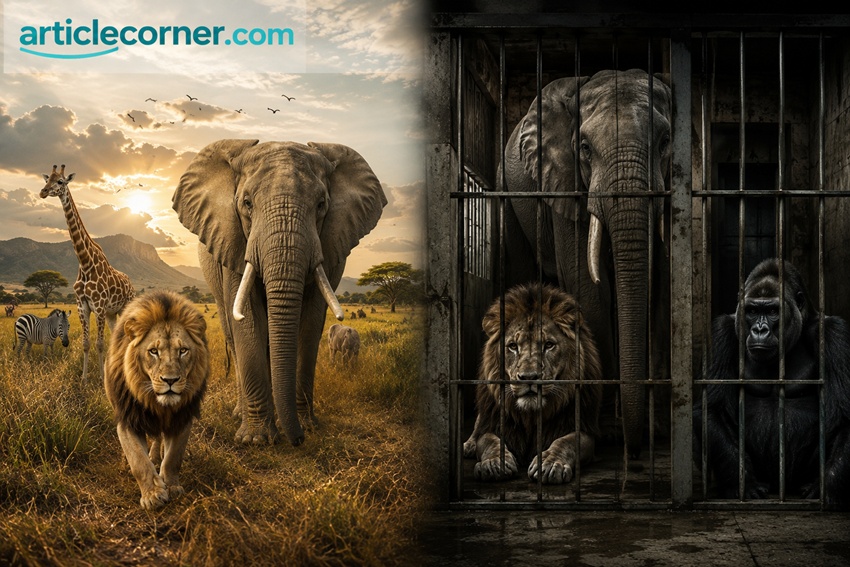
Every enclosure tells two different stories.
Visitors often see an exciting encounter with wildlife. The animal may experience another ordinary day inside boundaries it never chose.
As our understanding of animals continues to grow, so does our responsibility toward them. Perhaps the real measure of our compassion is not how closely we can observe wild animals, but how willing we are to let them remain truly wild.
Writer: articlecorner.com