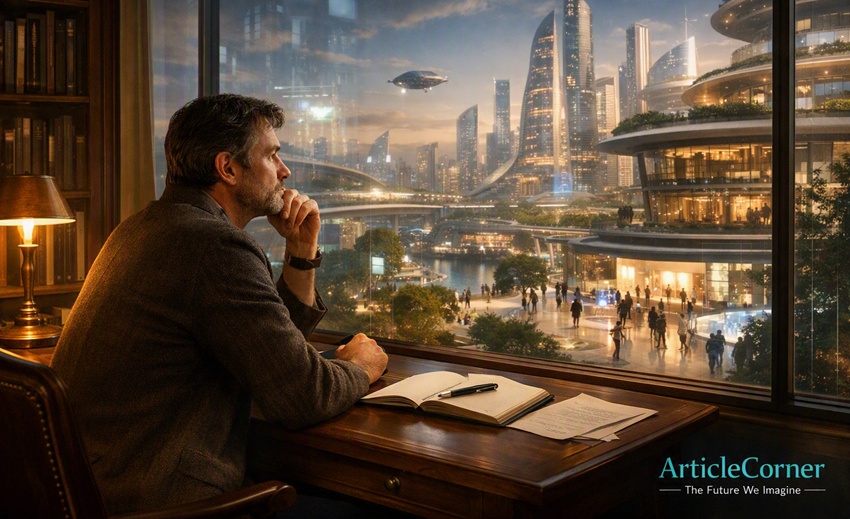
ArticleCorner City
Life in the Future: How Will People Live?
Sometimes I wonder what comes to mind when we say “the future.” Flying cars? Robots walking through our cities? Artificial intelligence everywhere? Skyscrapers reaching into the clouds? It is easy to imagine the future as a world filled with impressive technology. But maybe we are looking at it from the wrong direction. Maybe the biggest change will not be the machines around us. Maybe it will be the way we live our lives.
Think about an ordinary morning. You wake up, get ready, go to work, meet people, shop, earn money, come home and spend time with your family.
Now imagine doing the same things thirty or fifty years from now. Will “going to work” even mean the same thing? Will shopping mean walking into a store? Will children learn in classrooms? Will families spend their evenings together, or will everyone be living inside their own digital world?
These questions are much more interesting to me than simply asking what the next robot will look like.
Because the real future is not really about machines. It is about us.
Today, work, family, money, education and social life are tightly connected. But technology is already beginning to loosen some of those connections. In the future, people may live longer and work less. Some professions may disappear, while completely new ones appear that we cannot even imagine today.
And artificial intelligence may eventually move far beyond simply performing tasks that currently require human workers.
It could become a constant intellectual partner, capable of understanding complex situations, connecting enormous amounts of information, anticipating problems before they appear, designing new solutions and helping people make decisions in ways we can hardly imagine today.
AI may work alongside doctors, engineers, teachers, scientists, artists and entrepreneurs, not simply by following instructions, but by discovering possibilities that humans might never notice on their own.
It may even become part of the infrastructure of everyday life.
Homes, cities, transportation systems, hospitals, schools and businesses could continuously learn from the world around them and adapt in real time. Instead of asking a machine to complete a task, people may simply describe what they want to achieve, while intelligent systems determine the best way to make it happen.
The most remarkable change, however, may not be that machines become better at doing human work. It may be that humans begin to think differently because they have intelligent partners beside them. The boundary between what we imagine and what technology can create may become increasingly difficult to see.
So perhaps one day the question will no longer be “What job do you have?”
Maybe people will start asking something much more difficult:
“What makes your life meaningful?”
That is a very different question.
Work has never been only about money. Work gives people a feeling of usefulness. It gives them a place in society. It allows them to create something, meet other people and feel that they are moving toward a future.
If machines eventually take over a large part of these responsibilities, humanity may have to rediscover something it has almost forgotten how to do: decide what to do with its time.
And this brings us to another fascinating part of the future: shopping and commerce.
Imagine telling your digital assistant, “I need a comfortable chair for my living room.”
Instead of opening ten websites and comparing hundreds of products, your assistant could instantly examine thousands of chairs, compare prices, materials, quality, delivery times and customer reviews, and then show you the few choices that actually fit your needs.
You might not even need to visit a store.
But perhaps physical stores will not disappear. They may simply become something different. Instead of going there because you have to buy something, you may go there because you want to experience it.
Imagine walking into a furniture store wearing lightweight smart glasses. You look at a sofa and suddenly see it inside your own living room. You change its color with a gesture. You move it closer to the window. You see how it looks at night.
Or imagine trying on clothes without changing your clothes at all. Or walking through a virtual hotel room before booking your holiday. Or visiting a store thousands of kilometers away without ever leaving your city.
Shopping could become less about searching and more about experiencing.
And that could completely change the meaning of commerce.
Businesses may no longer compete only through price, location or advertising. Trust, experience, personalization and the relationship between a company and its customers could become far more important.
A small business in a quiet town could potentially reach customers on the other side of the world. Artificial intelligence could handle translation, payments, logistics and customer communication almost invisibly in the background.
A customer could discover a handmade product from a creator thousands of kilometers away and order it as easily as buying something from the shop around the corner.
The future marketplace could therefore become both more global and more personal.
And then there is something even closer to us: family.
Family life has already changed dramatically compared with the past. In the future, people may marry later, have fewer children or create new forms of family life. Longer lifespans could also create family structures that feel completely different from what we know today.
Imagine living long enough to spend many decades with your children, your parents and perhaps even your great-grandchildren.
Technology could make it incredibly easy to stay connected. A family member living thousands of kilometers away could appear on a screen almost as if they were sitting across the table.
But there is an interesting contradiction here.
We could become connected to everyone and disconnected from the people sitting next to us.
Imagine a family sitting together in the same room, each person wearing their own smart glasses, each one seeing a completely different digital world.
Perhaps the thing that protects families in the future will not be better technology.
Perhaps it will simply be the decision to put the technology aside and give each other some time.
Children may experience an even more dramatic transformation.
Imagine a child growing up with an artificial intelligence companion that can answer questions at any hour of the day. The child does not understand a mathematics lesson? The AI explains it again. Still confused? It explains it in another way. The child learns quickly? The system moves forward. The child needs more time? It waits.
Education could become incredibly personalized.
But there is something machines cannot easily replace.
Children learn more than information at school. They learn how to make friends. They learn how to share. They argue and make peace. They experience failure. They hear opinions they disagree with. They discover that other people have feelings, dreams and fears too.
If future children receive every answer from machines but have fewer opportunities to understand other human beings, we could create a society that is extremely knowledgeable but surprisingly poor at understanding one another.
Perhaps the most important subject in the future classroom will therefore not be mathematics, programming or artificial intelligence.
It may simply be how to be human.
Politics will also enter this new world.
Artificial intelligence could analyze enormous amounts of information, predict traffic, understand economic trends, identify problems in cities and help governments plan public services.
Imagine a city where an intelligent system can predict where hospitals will be needed, where traffic will increase, how much electricity people will consume and which neighborhoods may need additional public services.
Sounds efficient, doesn't it?
But then comes the difficult question.
Should everything that can be calculated also be decided by a machine?
Human life is not a spreadsheet.
Justice, freedom, equality, conscience and human dignity cannot always be reduced to the answer with the highest numerical score.
The politics of the future may therefore involve a fascinating struggle between technological efficiency and human judgment.
And society itself could become even more interesting.
Two people may live on the same street, enter the same supermarket and walk through the same park, yet live inside completely different digital realities.
One person's artificial intelligence may show them news, music, friends and ideas based on their interests. Another person may receive an entirely different digital world.
Personalization will make life easier, but it may also create a strange problem.
What happens when everyone lives in their own version of reality?
There was a time when millions of people read the same newspapers, watched the same television programs and gathered in the same public spaces.
The future could be very different. Instead of one shared digital world, we may each carry our own.
Finding ways to preserve common values, shared experiences and a sense of belonging could become one of the biggest social challenges of the future.
And then we arrive at the place where all these changes come together: the city.
Today, we think of a city as roads, buildings, shops, offices, parks and public squares.
Tomorrow, we may think about something else.
How intelligent is the city?
Traffic systems could predict where people are going before they arrive. Buildings could monitor their own energy consumption. Public transportation could automatically adjust itself according to demand. Energy networks could distribute electricity according to real time needs.
Even traffic lights might quietly make thousands of decisions every day without us noticing.
This is where the idea of ArticleCorner City becomes particularly interesting.
Because a future city should not simply be a city full of technology. It should be a city designed around people.
A city can be incredibly intelligent, perfectly connected and technologically advanced.
But if people are lonely while living inside it, can we really call it a successful city?
Maybe the smartest city will not be the one with the most technology.
Maybe it will be the one where people simply feel good living there.
Augmented reality could make this future even more fascinating.
Today, we usually enter the digital world by looking at a screen. Tomorrow, the digital world may simply appear around us.
Imagine walking through an old city street and looking at a historic building. Your smart glasses recognize it and instantly show you what the building looked like hundreds of years ago.
You continue walking and the street slowly transforms before your eyes. Ancient buildings appear where modern ones stand today. Historical figures seem to walk through the street. Information appears only when you want it.
You are still physically standing in the present, but for a moment, you are also visiting the past.
The same technology could transform shopping, tourism, education and entertainment.
Point your glasses toward a product and you could see its origin, price, reviews and possible uses. Walk into a museum and information could appear naturally around the exhibits. Visit another country and translation could happen almost instantly.
The boundary between the physical and digital worlds may become so natural that we eventually stop thinking about where one ends and the other begins.
And perhaps the biggest transformation will not be technological at all.
It may be our definition of prosperity.
Today, prosperity is often measured by income, the size of a home, the car we drive or the things we own.
But what if the future changes that definition?
What if people begin to value free time, clean air, safe streets, nature, healthy relationships and peace of mind just as much as money?
Perhaps one day the question will not be:
“How much do I own?”
It will be:
“How well am I living?”
And maybe the richest person of the future will not be the person who owns the most things.
It may be the person who controls their own time.
There is another strange paradox waiting for us.
Technology may eventually give us more free time than any generation before us. Machines could take care of many responsibilities, while artificial intelligence handles tasks that currently consume hours of our lives.
But having more free time does not automatically make us happier.
Sometimes people are unhappy not because they are too busy, but because they do not know what they are living for.
So perhaps when machines begin doing more of our work, humans will return to some very old things.
Art.
Music.
Hobbies.
Nature.
Travel.
Family.
Friendship.
Conversation.
Maybe the greatest luxury of the technological age will not be owning a futuristic machine.
It will be having time that truly belongs to you.
When we step back and look at the whole picture, I don't think the future will completely disconnect us from the life we know today.
Humans will change. Technology will change. Cities will change. The way we work, shop, learn and communicate will certainly change.
But some things will probably remain remarkably familiar.
People will still want to be loved.
They will still want security.
They will still worry about their children.
They will still want respect, friendship, hope and a reason to wake up in the morning.
Technology may completely change how we experience these things.
But perhaps it will never completely replace the need for them.
Maybe even in the most advanced city on Earth, surrounded by artificial intelligence, autonomous vehicles, holograms and smart buildings, someone will still come home in the evening, sit down and simply want to talk to someone they love.
And that is why I don't think the future should be told only as a story about robots, artificial intelligence and smart cities.
The real story will still be the story of humanity.
Technology may give us incredible possibilities. It may make life easier. It may connect the world in ways we cannot yet imagine.
But technology will not decide what kind of world we want to live in.
We will.
Will we build a world that is richer but lonelier?
A world that is more connected but less human?
A world that is technologically advanced but less fair?
Or can we build something better?
A future where technology helps people live with greater freedom, dignity, prosperity, connection and happiness.
Perhaps that is the real challenge waiting for us.
Not simply building smarter machines.
Not simply creating smarter cities.
Not simply making technology faster.
The most important question may be much closer to home.
What kind of human being do we want to become in the middle of all this progress?
Maybe the future does not begin when the first flying car takes off.
Maybe the future begins the moment we start asking what kind of life we actually want to live.
And perhaps that is exactly where our conversation about the future should begin.
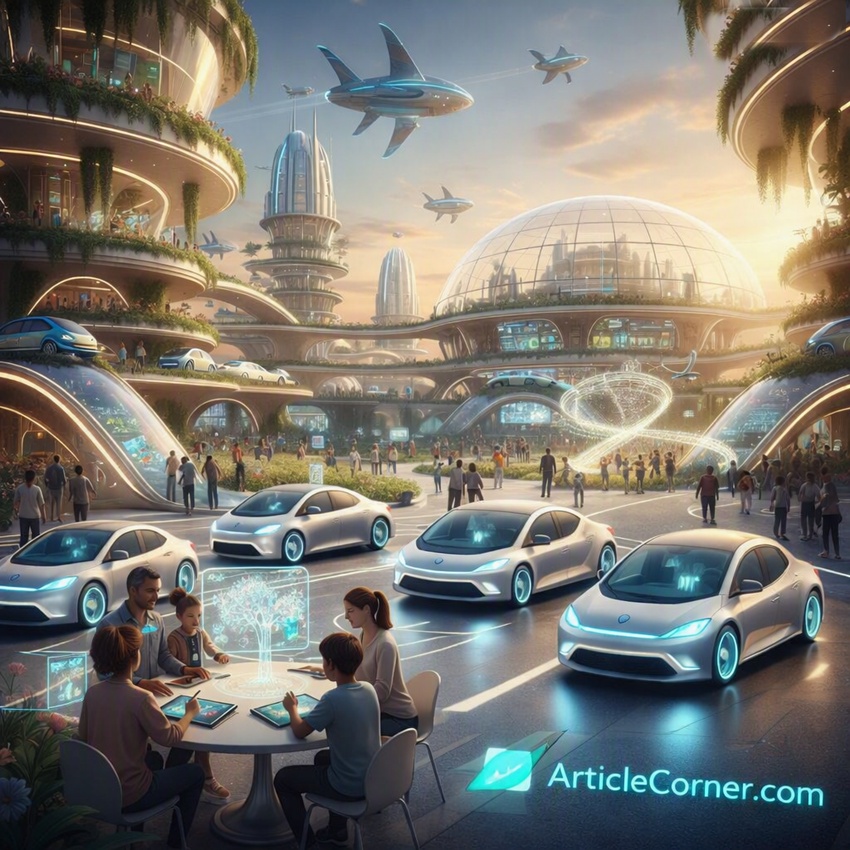
ArticleCorner City: We Imagine Tomorrow. We Put It Into Words.
Writer: articlecorner.com